
AI-narrated version of this post using a synthetic voice. Great for accessibility or listening while busy.
Affiliate disclosure: As an Amazon Associate, History Book Tales earns from qualifying purchases at no additional cost to you.
Old maps get things wrong in ways that are more interesting than if they’d gotten them right. A 16th-century world map with an oversized California drawn as an island, or a medieval mappa mundi with Jerusalem at the exact center of the world, isn’t a mistake to correct — it’s a direct window into how that era’s mapmakers understood their place in the world, what they’d actually seen versus what they’d only heard about, and what mattered enough to draw at all. A reproduction of one of these maps on a wall does something a modern atlas can’t: it shows you someone else’s worldview, literally.
Globes carry a slightly different appeal. A well-made globe replica, especially one styled after 18th or 19th-century cartographic globes, turns geography into an object you can turn in your hands rather than a flat image you scroll past. For a history-minded room — a study, an office, a reading nook — a globe does real decorative work while also being a genuinely functional reference piece, which is a combination most decor items don’t offer.
What “Museum-Quality” Actually Means Here
The phrase gets used loosely in product listings, so it’s worth being specific about what separates a real reproduction from a cheap poster with old-map clip art on it.
Source accuracy. A genuine reproduction is scanned or photographed from an actual historical map or globe held in a museum, library, or private collection, then reproduced at high resolution. A generic “vintage-style” product may be an artist’s modern invention meant to look old rather than a copy of something that actually existed — both can look attractive, but only one is historically accurate, and listings should specify which you’re getting.
Print/material quality. For flat maps, look for archival or giclée printing on heavier stock or canvas, which resists fading and yellowing far better than standard poster printing. For globes, cartouche detail, typography accuracy, and the quality of the base materials (real wood and metal versus painted plastic) separate a genuine decorative piece from a toy-grade one.
Scale and legibility. A reproduction that’s been shrunk down to fit a small poster size often loses the fine detail — ship illustrations, sea monsters, decorative borders, small place names — that made the original worth reproducing in the first place. Larger formats generally preserve more of that detail.
A Short History of the Globe as an Object
The oldest surviving terrestrial globe, the Erdapfel, was built in Nuremberg around 1492 by Martin Behaim — notably finished just before Columbus’s voyage reached the Americas, so it shows a world still missing an entire hemisphere. That accident of timing is part of why old globes and maps carry so much historical weight: they’re not just decorative, they’re dated evidence of exactly what a given culture knew, and didn’t yet know, at a specific moment. A 16th-century globe with a blank or speculative Pacific coastline tells you something a modern globe never could — not through an inscription, but through the shape of its own ignorance.
Dutch cartography dominated the following two centuries, and firms like the Blaeu family workshop turned globe- and map-making into a genuine art form, prized by European nobility as much for the craftsmanship and the display of wealth and learning as for practical navigation. Owning a fine globe in a 17th-century study signaled the same thing it still signals today, just at a much higher stakes level: this is a household that values knowing about the wider world. That symbolic function — less about literal navigation, more about signaling intellectual engagement with the world beyond your own horizon — is exactly what a reproduction globe or map still does in a modern study or office, even though nobody today is using it to actually plan a voyage.
Five Strong Picks
A Floor-Standing Antique-Style World Globe
This is the statement piece of the category — a full floor globe on its own stand, styled after 18th or 19th-century cartographic globes, complete with aged-looking ocean coloring and period-style typography. It works best in a room with genuine floor space to spare: a study, a home library, a formal living room corner. As a functional object it’s obviously outdated for actual navigation, but as a piece that anchors a history-themed room, nothing else on this list does quite the same job.

- Up-to- date National Geographic cartography
- Over 3000 place names and demarcations
- 16″ diameter globe ball
A Vintage-Style Desktop Globe
The same basic appeal in a much smaller footprint — a desk or bookshelf-sized globe with antique brass or wood detailing, sized for a room where a full floor globe simply won’t fit. This is the more common gift-giving size, since it works in a dorm room, a home office, or a corner of any bookshelf without requiring the recipient to rearrange furniture around it.

- Timeless Vintage Globe Design Bring old-world charm to your office, library, or study room with this beautifully crafted vintag…
- Elegant Antique Brass Finish Made with durable aluminium construction and finished in a rich antique brass tone, this decorativ…
- Smooth 360° Rotating Globe Designed with smooth horizontal and vertical rotation, allowing effortless viewing and interactive e…
A Large-Format Old World Map Print
A properly reproduced antique world map — something in the tradition of the great 16th- and 17th-century cartographers, with sea monsters in the oceans, compass roses, and hand-lettered place names — makes for genuinely striking wall art in a way a modern political map never will. Size matters more here than with almost any other item on this list: a small print loses the decorative detail entirely, while a large-format version (36 inches or wider) lets that detail actually read from across a room.

- Historic World Map Reproduction – This vintage cartography artwork showcases Le Globe Terrestre by Jean Baptiste Nolin, a baroq…
- Unframed Print – Delivered as a reproduction print (not on wood, slate, or matboard), this antique map poster is ready to frame…
- Makes a Great Gift – A thoughtful gift for map collectors, history lovers, teachers, and students. Great for birthdays, graduat…
A National Geographic-Style Historical Map Reproduction
For a slightly more accessible price point and generally reliable print quality, historical map reproductions in the National Geographic tradition cover specific historical moments rather than just general old-world cartography — a particular war’s campaign map, a historical empire at its territorial peak, a specific expedition’s route. These work especially well for someone with a specific era or region of interest rather than a general love of old maps, since you can match the map’s subject to their particular corner of history.
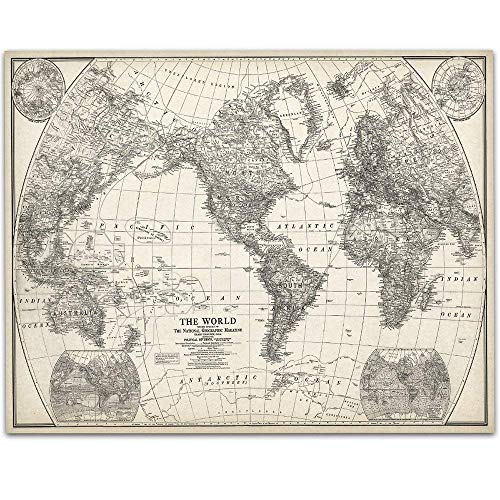
- Artwork Info – Features a reproduction of a detailed 1922 world map published by the National Geographic Society, displaying gl…
- Unframed Print – Professionally printed using archival-quality inks on premium paper to preserve the fine cartographic lines, g…
- Makes a Great Gift – A distinctive decor choice for map collectors, cartography enthusiasts, history lovers, travelers, geograp…
An Antique Nautical Chart Reproduction
A slightly different category from general world maps — nautical charts emphasize coastlines, depth soundings, and navigational detail over broad continental geography, and they carry a distinct maritime-history appeal for anyone interested in the age of sail, naval history, or exploration specifically. These tend to work well in smaller formats than general world maps do, since the interesting detail is concentrated along coastlines rather than spread across the whole image.

- Unique Design: Modern Canvas Print Artwork With Beautiful Patterns, Rich Color Layers And Exquisite Details, Adding An Artistic…
- High Quality: The Interior Is Inlaid With A Sturdy Wooden Frame, The Canvas Is Made Of High-Quality Canvas Material To Ensure D…
- Room Decoration: The Design Is Suitable For A Variety Of Interior Styles, You Can Decorate In The Living Room, Bathroom, Bedroo…
Comparison Table
| Item | Typical price | Space needed | Best for |
|---|---|---|---|
| Floor-standing globe | $150-500+ | Significant floor space | Studies, libraries, formal rooms |
| Desktop globe | $40-150 | Desk or shelf | Offices, dorms, bookshelves |
| Large map print (framed/canvas) | $80-300+ | Substantial wall space | Living rooms, studies, entryways |
| Smaller historical map reproduction | $20-60 | Any wall | Gifts, smaller rooms, layered gallery walls |
| Nautical chart reproduction | $20-70 | Small-medium wall space | Maritime/naval history enthusiasts |
Lighting and Placement Matter More Than People Expect
A map or globe’s fine detail — the small type, the decorative flourishes, the subtle color variation across old paper or aged-look ocean regions — disappears fast under poor lighting, which means placement decisions affect how much you actually get out of a piece as much as the piece’s own quality does. Direct overhead lighting tends to wash out fine detail on a globe’s curved surface, while angled or side lighting brings out texture and relief far better. For wall-mounted maps, a picture light or a well-placed reading lamp nearby does more for legibility than most people initially assume, especially for large-format prints where the appeal is entirely in detail that only reads up close.
Placement relative to daily use matters too. A floor globe or a large map print works best somewhere it gets looked at repeatedly rather than walked past — near a reading chair, behind a desk, in a hallway that sees regular foot traffic rather than a rarely used formal room. A piece that’s technically on display but never actually seen up close loses most of what makes it worth owning in the first place.
Matching the Piece to the Room
A floor globe is a genuine commitment — it needs real space and works best as the room’s focal point rather than one item among many, so it’s worth confirming the recipient (or you) actually have a spot for it before buying. A desktop globe solves the same problem with none of that risk, which makes it the safer default gift in this category. For wall art, err toward the larger format if budget allows; a map’s decorative value comes almost entirely from its fine detail, and that detail is the first thing lost when a reproduction gets printed too small. If you’re buying for someone with a specific historical interest rather than a general one, the National Geographic-style era-specific maps and the nautical charts both let you match the piece directly to what they actually care about, which tends to land better than a generic old-world map.
For a smaller, less wall-space-dependent way to bring history into a room, see our ancient Rome and Greece collectible replicas guide, which covers desk and shelf pieces in a similar spirit.
Frequently Asked Questions
Are these reproductions historically accurate, or stylized?
It depends entirely on the specific product, which is why source accuracy is worth checking before buying. A genuine reproduction is copied from a real historical map or globe; a “vintage-style” or “antiqued” product may be a modern design meant to evoke that look without being a copy of anything that actually existed. Both are legitimate purchases, but they’re different things, and listings should say which you’re getting.
Will a large map print fade over time?
Some will, especially cheaper poster-stock prints in direct sunlight. Archival or giclée prints on canvas resist fading significantly better. Hanging any print out of direct sunlight extends its life regardless of print quality.
Do floor globes require any assembly?
Most do — typically attaching the globe sphere to its stand or base, which usually takes a few minutes with included hardware. It’s worth checking a specific listing’s assembly requirements if that’s a concern, since designs vary.
What’s the difference between a reproduction and an antique original?
A reproduction is a modern, newly manufactured copy of an old map or globe design, sold at a fraction of the cost of an actual antique. A genuine antique original of a historically significant map or globe, if it exists on the market at all, would typically run into the thousands of dollars or far higher through auction houses and specialty dealers, not standard retail.
Are these appropriate for a home office, or too decorative for a professional space?
A floor globe or a well-chosen historical map reads as genuinely professional in a home office or study — it’s a common feature in academic and legal offices specifically because it signals intellectual interest without being flashy. A desktop globe in particular is a safe, tasteful choice for shared or client-facing workspace.
Related Auburn AI Products
Building a content site at scale? Auburn AI has production-tested kits: