AI-narrated version of this post using a synthetic voice. Great for accessibility or listening while busy.
Affiliate disclosure: As an Amazon Associate, History Book Tales earns from qualifying purchases at no additional cost to you.
The Cold War lasted more than four decades, spanned every continent and was fought through proxy wars, spies, propaganda, space programmes and an arms race that came close to ending everything. It is also recent enough that archives in Moscow, Eastern Europe and Washington have only gradually opened, which means the best books on it keep getting better.
This guide picks seven books that work together: two overviews at very different lengths, then a run of books on the key flashpoints, from the Soviet grip on Eastern Europe to the Berlin crisis, the espionage war and the nuclear standoff of the 1980s. It ends with a new release from Michael Dobbs due out on October 20, 2026. The choices are based on publisher descriptions, the authors’ reputations and reader reviews.
Quick Picks
- Best short overview: The Cold War by John Lewis Gaddis
- Best comprehensive global history: The Cold War by Odd Arne Westad
- Best on Soviet Eastern Europe: Iron Curtain by Anne Applebaum
- Best on the Berlin Wall crisis: Berlin 1961 by Frederick Kempe
- Best spy story: The Spy and the Traitor by Ben Macintyre
- Best on the late arms race: The Dead Hand by David Hoffman
- New release, out October 20, 2026: The Six Minute War by Michael Dobbs
The Overviews
The Cold War: A New History by John Lewis Gaddis
Gaddis, a Yale historian who has spent his career on the subject, wrote this deliberately short book with students and newcomers in mind. In 352 pages it covers the whole conflict from 1945 to the Soviet collapse, organized around big themes rather than a strict timeline: the logic of nuclear deterrence, the appeal and failure of competing ideologies, and the role of individual leaders such as Reagan, Gorbachev and Pope John Paul II in bringing it to an end.
Gaddis writes from a broadly American perspective and some readers find his view of the West’s conduct generous. As a clear, confident first book, though, it is hard to beat.

The Cold War: A World History by Odd Arne Westad
Westad’s book is the natural second step and the counterweight to Gaddis. At 720 pages it is far more detailed, and it treats the Cold War as a global system rather than a two-player contest. Westad traces the rivalry’s roots back before 1945 and gives full weight to China, the decolonizing world, Latin America and the Middle East, where much of the actual fighting and dying took place.
Readers who want to understand why the Cold War shaped places like Korea, Vietnam, Angola and Afghanistan will find this the most complete single account available.

The Flashpoints
Iron Curtain by Anne Applebaum
How did the Soviet Union turn the countries its armies occupied in 1944 and 1945 into obedient satellites so quickly? Applebaum answers by focusing closely on Poland, Hungary and East Germany, using archives and interviews to show how secret police, control of radio, the dismantling of churches, youth groups and independent organizations, and selective terror were used to remake whole societies. The book covers the years from 1944 to 1956.
It is a grim but gripping read, and it explains the Europe that Berlin, Budapest and Prague became for the rest of the Cold War.

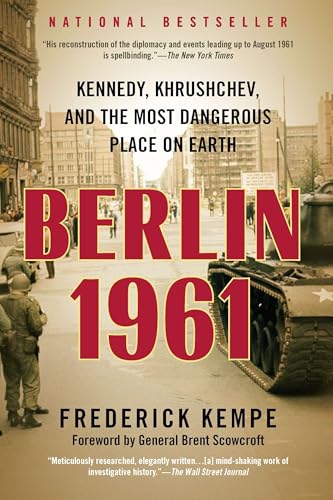
Berlin 1961 by Frederick Kempe
Kempe, a former Wall Street Journal editor and correspondent, focuses on a single year in a single city: the year the Berlin Wall went up. He follows the young President Kennedy and Soviet leader Nikita Khrushchev from their tense summit in Vienna through the building of the Wall in August to the October standoff between American and Soviet tanks at Checkpoint Charlie. Kempe’s argument, which some readers find provocative, is that Kennedy’s caution in Berlin encouraged Khrushchev to gamble in Cuba the following year.
It reads like a political thriller and makes a natural pairing with our account of the Cuban Missile Crisis naval blockade.
The Spy War
The Spy and the Traitor by Ben Macintyre
This is the Cold War book people give to friends who say they do not read history. Macintyre tells the true story of Oleg Gordievsky, a KGB officer who secretly worked for British intelligence for more than a decade, rose to be named head of the KGB station in London, and gave the West a rare view into Soviet thinking during the dangerous early 1980s. When he was suddenly recalled to Moscow in 1985, MI6 had to attempt an escape plan it had prepared years earlier but never expected to use.
The story also involves Aldrich Ames, the CIA officer who sold secrets to the Soviets. Macintyre’s pacing is excellent, and readers regularly describe staying up late to finish it.

The Nuclear Standoff
The Dead Hand by David E. Hoffman
Hoffman, a longtime Washington Post correspondent who reported from Moscow, won the Pulitzer Prize for General Nonfiction for this history of the arms race in its final, most dangerous decade. Drawing on Soviet documents and interviews, he follows the Reagan-Gorbachev years, the Soviet Union’s secret biological weapons programme, and the semi-automatic retaliation system that gives the book its title. He also covers what happened to the weapons and the scientists after the Soviet collapse.
At 577 pages it is detailed, but the subject matter is so startling that it rarely drags.

New This Month
The Six Minute War by Michael Dobbs
Michael Dobbs, a former Washington Post foreign correspondent, is best known to Cold War readers for One Minute to Midnight, his hour-by-hour history of the Cuban Missile Crisis. His new book, The Six Minute War: Reagan, Russia, and the Race to Automate Armageddon, is scheduled for release on October 20, 2026, as a 352-page hardcover. As the subtitle indicates, it returns to the nuclear confrontation of the Reagan years, the same period covered by The Dead Hand, and the push to automate decisions about nuclear war.
Since it is not yet out, there are no reader reviews to go on. On the strength of Dobbs’s earlier work it is a title worth watching this autumn, and it is available to pre-order now. For more new titles in the field, see our list of the newest history book releases.

Where to Start
Start with Gaddis for a short overview, or Westad if you want depth from the beginning. Then pick a flashpoint: Applebaum for Eastern Europe, Kempe for Berlin, Hoffman for the arms race. Macintyre is the best choice for a reader who wants a page-turner, and Dobbs’s new book is the one to watch this month. If your interest in the period starts earlier, our roundup of bestselling WWII history books covers the war that set up the Cold War.
Frequently Asked Questions
When did the Cold War start and end?
Most historians date it from the years just after the Second World War, around 1946 to 1947, to the dissolution of the Soviet Union in December 1991. Some, including Odd Arne Westad, trace its roots much further back, to the late nineteenth century and the Russian Revolution of 1917.
What is the best single book on the Cold War?
For a short introduction, John Lewis Gaddis’s The Cold War: A New History is the most common recommendation. For a comprehensive global account, Odd Arne Westad’s The Cold War: A World History is the standard choice.
Is The Spy and the Traitor a true story?
Yes. Ben Macintyre’s book is nonfiction, based on interviews with Oleg Gordievsky and with intelligence officers involved in his case.
When does Michael Dobbs’s The Six Minute War come out?
The hardcover is scheduled for release on October 20, 2026, according to its Amazon listing at the time of writing.
Why is it called the Cold War?
Because the United States and the Soviet Union never fought each other directly in a full-scale war. The rivalry played out through the arms race, espionage, propaganda, economic competition and proxy wars fought elsewhere.