
AI-narrated version of this post using a synthetic voice. Great for accessibility or listening while busy.
Affiliate disclosure: As an Amazon Associate, History Book Tales earns from qualifying purchases at no additional cost to you.
Family history research and general history-reading interest are close cousins but not the same hobby. A history enthusiast reads about the past as something that happened to other people, in aggregate, at scale. Genealogy research is the same historical curiosity turned inward — the same interest in migration patterns, wars, famines, and social change, but traced through one specific family line rather than a whole civilization. For a lot of history readers, a DNA kit or genealogy research tool is where that reading interest turns into something personal and active rather than purely observational.
It’s also, unusually for this list, a category with a genuinely large and growing search-and-purchase market well beyond the history-enthusiast audience specifically. Millions of people test every year, largely disconnected from any particular interest in history as a subject — which makes this one of the more broadly appealing gift categories here, useful for a history-minded recipient and a much wider audience alike.
What a DNA Kit Can and Can’t Tell You
Worth being direct about this before comparing services, because expectations matter a lot here.
What it’s genuinely good at: ethnicity estimates (broad regional ancestry percentages, refined over time as databases grow), connecting with genetic relatives who’ve also tested, and in some cases flagging genetic health predispositions (only on services that offer that as a separate, often opt-in feature).
What it’s not: a precise, name-by-name family tree. DNA testing estimates broad ancestral origins and finds genetic matches; it doesn’t hand you a documented lineage back to specific named ancestors. That kind of detailed tree-building requires pairing DNA results with actual genealogical research — census records, birth and marriage certificates, immigration records — which is a separate (if related) activity these companies also support through their record databases, typically as part of a subscription tier beyond the base DNA test.
Accuracy over time. Ethnicity estimates shift as a company’s reference database grows and its algorithms improve — it’s normal, even expected, for an estimate to change somewhat a year or two after initial results as the underlying data pool expands.
Setting Expectations for a First-Time Tester
A first set of results rarely resolves every question a family has been curious about, and it’s worth framing the gift that way rather than promising more certainty than the technology delivers. Ethnicity estimates arrive as broad regional percentages rather than a neat list of named countries, and genetic matches show up as a list of other test-takers with varying degrees of relatedness rather than a ready-made family tree. The real value tends to compound over the following months and years, as more relatives test, as match lists grow, and as each company’s reference database expands and refines its estimates. Treating a DNA kit as the start of an ongoing research project, rather than a single definitive answer delivered a few weeks after mailing in a sample, sets a much more accurate expectation for what the recipient will actually get out of it.
Comparison Table
| Service | Database size (approx.) | Strongest for | Health reports | Record access |
|---|---|---|---|---|
| AncestryDNA | Largest consumer database | Genealogical record matching, family tree building | Limited/add-on | Extensive (subscription-based) |
| 23andMe | Large | Health & wellness reports, ethnicity breakdown | Strongest health-report option | Limited compared to Ancestry |
| MyHeritage | Large, strong in European records | International/European ancestry research | Add-on available | Strong for European records specifically |
How Consumer DNA Testing Actually Works
It’s worth understanding the mechanics briefly, since it explains both what these tests are good at and where their real limits sit. A saliva or cheek-swab sample gets processed for hundreds of thousands of specific points across your DNA called SNPs (single nucleotide polymorphisms) — small variations that differ between individuals and, in aggregate, differ in predictable patterns between populations with different geographic ancestry. Your results get compared against a reference panel of people with well-documented ancestry from specific regions, and the ethnicity estimate you receive is a statistical best-fit against that reference panel, not a direct reading of “where your ancestors came from” in any absolute sense.
That’s exactly why estimates shift over time and why they can differ somewhat between companies testing the same person: each company’s reference panel is built differently, updated on its own schedule, and weighted by its own methodology. A company with a larger and more geographically diverse reference panel will generally produce a more refined regional estimate than one with a smaller panel, which is part of why database size matters as much as it does when comparing services. None of this makes the results unreliable, but it does mean an ethnicity estimate is closer to “our best current statistical read of your genetic ancestry” than a fixed, permanent fact about your family history — worth keeping in mind both when interpreting your own results and when explaining them to a relative unfamiliar with how the technology works.
Three Strong Picks, Plus a Companion Tool
AncestryDNA
Ancestry operates the largest consumer genetic database and pairs it with the deepest record-search ecosystem of the major services — census records, immigration manifests, military records, historical newspapers. For someone whose real goal is building an actual documented family tree, not just an ethnicity percentage, Ancestry’s combination of a large match pool and extensive record access makes it the strongest overall pick. The trade-off: full record access requires an ongoing subscription beyond the one-time DNA kit cost, which is worth budgeting for if serious tree-building is the goal.

- TOP-SELLING CONSUMER DNA TEST: From your origins in over 3,600+ places around the world to the most connections to living relat…
- YOUR DATA, YOUR CONTROL: We give you full control over your genetic information. You decide what to share, and with whom.
- DNA + TRAITS: Ever wondered where your freckles came from, or why you hate cilantro? AncestryDNA + Traits lets you discover 75+…
23andMe
23andMe built its reputation on the health and wellness side of testing as much as the ancestry side, offering reports on genetic health predispositions, carrier status, and traits alongside standard ethnicity estimates — a combination none of the other major services match as directly. For someone whose interest splits between family history and personal health information, or who’s specifically curious about the health-report angle, 23andMe remains the clearest choice in that dual-purpose lane.
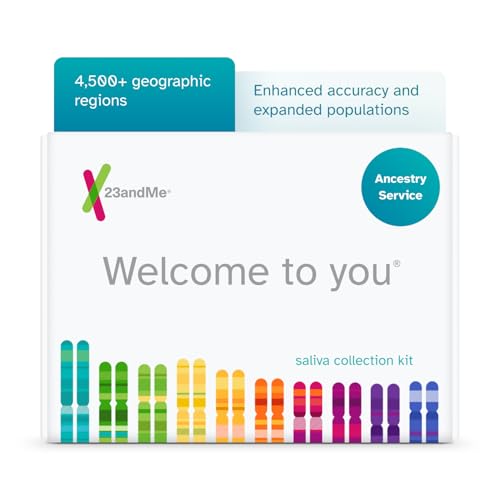
- WHAT YOU GET: At-home DNA test kit with access to the most detailed geographic breakdown, sometimes to the specific valley—or e…
- ANCESTRY FEATURES: Dig deeper into your ancestry with even more enhanced accuracy and the most comprehensive DNA ancestry test….
- TRAIT REPORTS: Find out what makes you, you with personalized trait reports. Uncover the science behind your unique characteris…
MyHeritage DNA
MyHeritage carries particular strength for European ancestry research specifically, with a record archive that’s especially deep for European historical documents relative to its competitors — a meaningful advantage for anyone whose known or suspected ancestry traces heavily to Europe. It’s a strong second opinion alongside another service’s results too, since comparing ethnicity estimates and match lists across two different companies’ databases can surface connections a single test might miss.

- Discover your ancestry and find relatives you never knew existed on both your maternal and paternal sides.
- Get a detailed ethnicity breakdown with the most comprehensive list of ethnicities in the industry: 42 regions, including 7 Eas…
- Simple DNA test kit with a cheek swab – takes only 2 minutes to complete.
A Genealogy Research Journal or Family Tree Record Book
A physical companion to any DNA testing service — a structured journal or binder for recording interview notes, documenting sources, and sketching out a family tree by hand. Even in an era of digital family-tree software, a lot of serious genealogists still keep physical notes for interviews with older relatives, since a notebook is a lot less intimidating across a kitchen table than a laptop, and it makes a genuinely thoughtful companion gift alongside a DNA kit rather than a purely digital, screen-bound gift.

- Preserve Your Legacy: Document your family’s unique journey, from ancestral origins and migrations to cherished traditions and…
- Comprehensive Genealogy Template: Features a user-friendly format with guided sections for tracing your family’s origins, explo…
- Premium Quality & Durable Design: Crafted with a sturdy plastic cover and robust spiral binding for longevity. The 100gsm thick…
Privacy Considerations Worth Knowing Before Buying
Consumer DNA testing raises real privacy questions that are worth understanding before gifting or buying a kit, not after. Testing services vary in their data-sharing policies, law enforcement cooperation practices, and options for deleting data or opting out of third-party research sharing. It’s worth reviewing a specific service’s current privacy policy and consent options directly, since these have shifted meaningfully across the industry in recent years and vary by company. This is also a genuinely personal decision to make on the recipient’s behalf; if you’re buying a kit as a gift rather than for yourself, it’s worth confirming the recipient is comfortable with genetic testing generally before surprising them with one, given how personal and occasionally sensitive the results (unexpected relatives, unexpected ethnic origins, health information) can turn out to be.
Should More Than One Family Member Test?
For serious genealogical research, yes, and it’s worth planning for rather than treating each kit as a one-off gift. Testing an older relative — a parent or grandparent, if they’re willing and able — captures a generation’s worth of genetic information that becomes permanently unavailable once that person is gone, since DNA passed down gets diluted and reshuffled with each generation and can’t be perfectly reconstructed from descendants alone. If there’s a specific elder in the family whose ancestry is a subject of ongoing curiosity or family debate, prioritizing their test over your own or a sibling’s often surfaces the most new information for the whole family tree at once, simply because their raw genetic data is one generation closer to the ancestors everyone is actually trying to learn about.
Which Service Fits Which Goal
For building an actual documented family tree, Ancestry’s database size and record access make it the strongest starting point despite the subscription cost required to reach full record access. For someone specifically curious about health and trait reports alongside ancestry, 23andMe remains the clearest choice in that combined lane. For known or suspected European ancestry specifically, MyHeritage’s record depth in that region gives it a real edge worth considering as either a first test or a strong second opinion. Whichever service you choose, pairing the kit with a genealogy journal turns a single DNA test into the start of an ongoing project rather than a one-time curiosity.
For readers whose family history research turns up specific historical periods or migrations worth reading more about, our broader World War II and general history coverage on this site is a natural next stop once a DNA test points toward a particular era or region of interest.
Frequently Asked Questions
Can I use results from one service to search another’s database?
Most major services allow uploading raw DNA data from a competitor’s test for a reduced fee or free, specifically to expand your match pool without paying for a second full test. This is a common and cost-effective way to check multiple databases without buying multiple kits.
How long does it take to get results?
Typically several weeks from when the sample is received by the lab, though this varies by service and by testing volume/season — results tend to take somewhat longer during major gifting periods when order volume spikes industry-wide.
Is a DNA test enough to build a full family tree on its own?
No — DNA testing identifies genetic relatives and estimates broad ancestral origins, but building a documented, named family tree requires pairing those results with actual genealogical records (birth, marriage, census, immigration documents), which is a separate research process the same companies typically support through their record-search platforms.
Are these kits appropriate as a surprise gift?
Approach with some caution. Because results can include unexpected findings (unknown relatives, unexpected ethnic origins, and in some cases health information), it’s worth confirming a recipient genuinely wants to test before surprising them with a kit, rather than assuming everyone will be equally comfortable with whatever the results turn out to be.
Do I need to test if a close relative already has?
Not necessarily for ethnicity estimates — siblings and parents share substantial genetic overlap, so one close relative’s results can suggest a lot about your own broad ancestry. However, each person’s individual matches and exact ethnicity percentages will still differ somewhat, so testing yourself remains the only way to get your own specific results and match list.
Related Auburn AI Products
Building a content site at scale? Auburn AI has production-tested kits: