
AI-narrated version of this post using a synthetic voice. Great for accessibility or listening while busy.
Valerie Hansen · Scribner, 2020 · 978-1-5011-9410-8
There is a particular pleasure for Canadian readers in a book whose argument runs straight through Newfoundland. Valerie Hansen’s *The Year 1000* takes the Norse landings on the island’s northern tip — the westernmost reach of a Scandinavian world that had already pushed through Iceland and Greenland — and treats them not as a curious dead end in the sagas but as the closing of a circuit. If Norse sailors reached the Americas around the year 1000, then the last great gap in the map of human contact had been bridged, and the world was, for the first time, connected end to end. From that observation Hansen builds a larger claim: globalization did not begin with Columbus and da Gama in the 1490s, but roughly five centuries earlier, along a set of trade routes that were already linking the world’s regions to one another.
The historian behind the argument
Hansen is the Stanley Woodward Professor of History at Yale, where she has taught since 1988 and held the chair since 2017. Her scholarly home ground is China and the Silk Road — she earned her doctorate at the University of Pennsylvania in 1987 with a dissertation on popular deities and social change in the Southern Song, and her early books worked from unglamorous, granular sources: temple cults in *Changing Gods in Medieval China*, and surviving contracts (some of them buried in tombs) in *Negotiating Daily Life in Traditional China*. From 1995 to 1998 she led the Silk Road Project that reunited, on paper at least, more than 3,000 documents and artifacts carried off from the Turfan oasis before the First World War and scattered across collections in Europe and Asia.
That background matters, because it tells readers what kind of world historian Hansen is. Her 2012 book *The Silk Road: A New History* argued something distinctly deflationary — that Silk Road trade was small in scale and usually involved local goods, not the glittering long-distance luxury traffic of popular imagination. A scholar who spent a career puncturing romantic assumptions about premodern trade is an interesting person to write a book claiming that the premodern world was more connected than we think. The two positions are not contradictory, but the tension between them is one of the more intellectually honest things about *The Year 1000*.
What works
The book’s great strength is its refusal to organize the eleventh century around Europe. Hansen is a genuine world historian by training and practice — she co-wrote the textbook *Voyages in World History* with Kenneth R. Curtis, now in its fourth edition, and her teaching at Yale includes a lecture course called The World Circa 1000. She has also done her thinking in the places she writes about: while working on this book she held visiting positions at Xiamen University, the University of Birmingham, and the Collège de France, where she lectured in 2019. The result is a narrative in which the Norse are one thread among many rather than the protagonists, and in which the reader is asked to hold several regions in mind at once.
It is also, for a book with an academic argument at its core, briskly readable. Hansen’s earlier work in *The Open Empire* was built on a contrarian thesis — that Indian Buddhists and northern nomadic peoples shaped China throughout its history, against a view that outsiders never really penetrated it — and she has long been comfortable making a case in plain language for readers who are not specialists. Scribner published *The Year 1000* in April 2020; it has since been translated into sixteen languages and drew mostly favourable reviews, which is a fair verdict.
Where readers should push back
The honest caveat is structural. A book that sweeps from Scandinavia to Southeast Asia to Mesoamerica cannot rest on the kind of primary-document work that made Hansen’s reputation. Much of it necessarily synthesizes other scholars’ regional expertise, and the evidentiary weight is uneven from chapter to chapter — sturdiest where she is closest to home, in China and along the Eurasian routes, thinner elsewhere.
The framing word is also doing a great deal of lifting. “Globalization” carries modern freight — integrated markets, price convergence, mutual economic dependence — and readers should decide for themselves whether the connections Hansen documents amount to that, or to something more like a chain of overlapping regional networks that happened, around the year 1000, to touch at every link. Hansen herself gave us the tools for that scepticism in *The Silk Road*. Skilled polemical framing is not the same thing as a proven case, and the subtitle promises more than any single volume can demonstrate.
The verdict
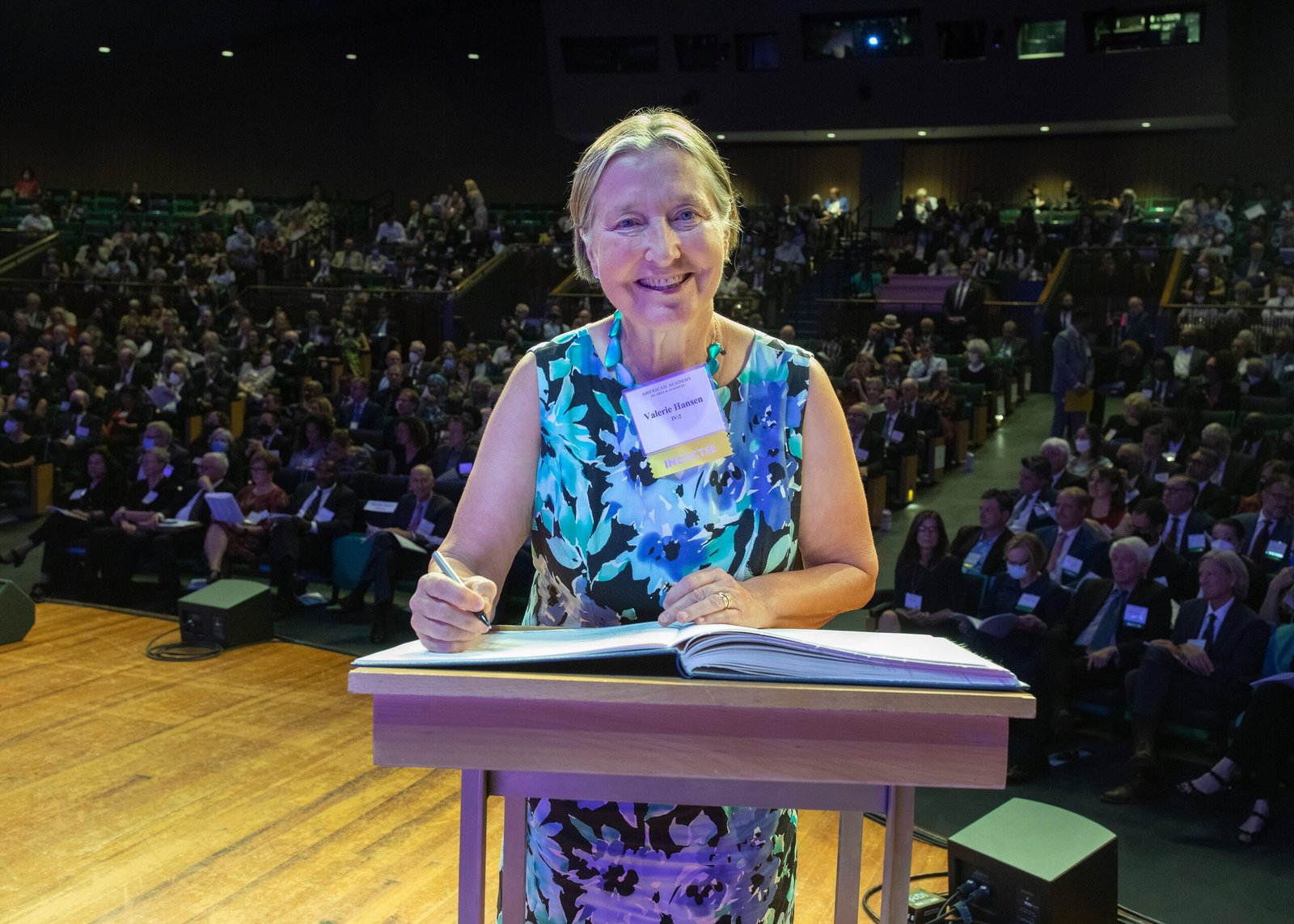
*The Year 1000* is a stimulating, well-paced work of popular world history by a serious scholar — the Gustav Ranis International Book Prize in 2013, election to the American Academy of Arts and Sciences in 2021 — writing slightly beyond her specialty and doing it well. Read it for the reorientation rather than the thesis: it will permanently change the mental map most readers carry of the eleventh century, and for Canadians it offers the rare experience of finding L’Anse aux Meadows at the hinge of a global story rather than in a footnote to one. Pair it with a more sceptical account of premodern trade — Hansen’s own Silk Road book will do nicely — and the argument becomes a conversation rather than a conclusion.
Recommended for: readers of global and connected history, anyone who suspects the story of the world got told backwards.