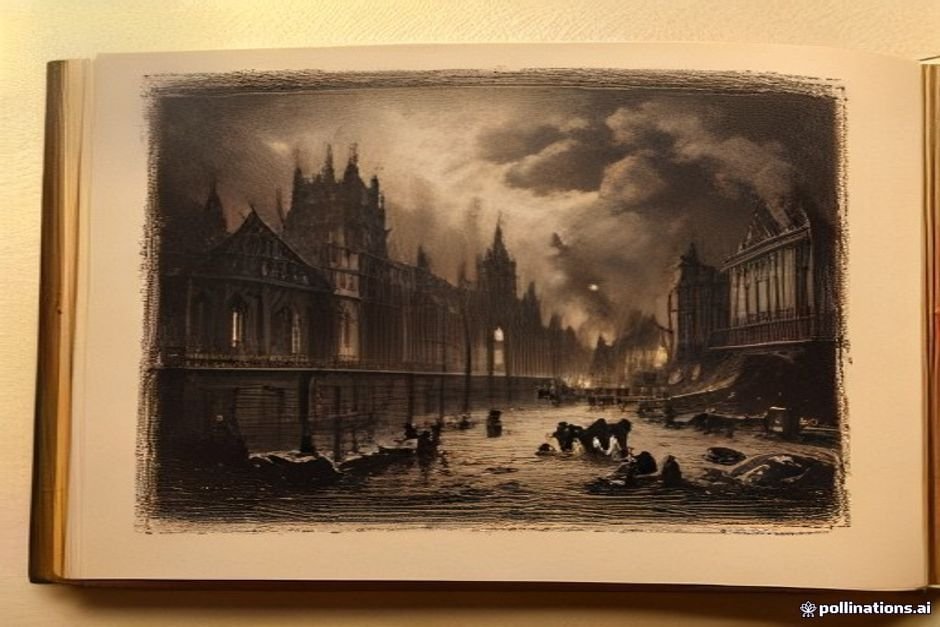
A frightened maidservant climbed out of an upstairs window above a bakery on Pudding Lane in the early hours of a September morning, too scared to jump to safety like the rest of the household. She became the first person to die in a fire that, over the next four days, would consume the heart of London. By the time the flames finally died down, a medieval city that had grown haphazardly for centuries was gone, and in its place stood the opportunity to build something new.
A City Built to Burn
London in the 1660s was enormous by the standards of the age, home to somewhere between 300,000 and 400,000 people, making it the largest city in Britain and the third largest in the Western world. John Evelyn, comparing it unfavorably to Paris in 1659, dismissed it as a “wooden, northern, and inartificial congestion of Houses” — unplanned, makeshift, grown without any real design. The City proper, the area enclosed by the old Roman wall, covered just 700 acres and held about 80,000 people, a quarter of London’s population, surrounded by a ring of crowded suburbs where most Londoners actually lived.
It was also, quite literally, built to burn. The street plan was medieval: a warren of narrow, winding, cobbled alleys that had already caught fire several times before, most recently in 1633. Builders were supposed to use stone and brick instead of wood and thatch, a rule that had been on the books for centuries, but cheap materials kept winning out. Only the wealthy center of the city, where merchants and brokers built their mansions, was reliably built from brick or stone. Everywhere else, overcrowded tenements rose storey upon storey, each floor jutting out slightly further than the one below in jetties that nearly met across the alleys overhead. As one observer put it, this arrangement helped a fire spread while also blocking any attempt to stop it.
The riverfront made things worse. The Thames offered water and a route of escape, but the wharves were packed with combustible stock — tar, pitch, hemp, rosin, flax — crammed in among tar-paper shacks and rickety tenements. Gunpowder was everywhere too, left over from the Civil War and stored by ship chandlers in wooden barrels along the river; the Tower of London alone held five to six hundred tons of it. Charles II had tried twice, in 1661 and again in 1665, to ban overhanging jetties and narrow streets, even threatening demolition and imprisonment for builders who ignored him. Local government largely ignored him right back.
There was also a political fault line running beneath the city. The City of London had been a stronghold of republican sentiment during the Civil Wars, and its magistrates — men who remembered exactly how Charles I’s reach for absolute power had ended — were wary of letting royal troops anywhere near their streets, even in an emergency. That wariness would cost them.
The Fire Takes Hold
The fire began a little after midnight on Sunday, 2 September 1666, at Thomas Farriner’s bakery on Pudding Lane. Everyone in the household escaped through an upstairs window except the maidservant, who was too frightened to follow and burned in the house when it collapsed. Neighbors tried to fight the flames, and within an hour parish constables arrived and decided the adjoining houses needed to come down to stop the spread. The owners objected, so someone sent for the Lord Mayor, Sir Thomas Bloodworth, to authorize it.
By the time Bloodworth showed up, the fire was already eating into the next houses and creeping toward the warehouses on the riverfront. Experienced firemen wanted demolition immediately. Bloodworth refused, worried that the buildings were rented and he couldn’t track down the owners to ask permission. He is generally believed to have gotten the job of Lord Mayor precisely because he was a yes-man rather than a capable administrator, and he folded under pressure, reportedly waving off the danger with the remark that “a woman might piss it out” before leaving the scene. The firebreak never happened. The wind, blowing hard from the east, had already turned a bakery fire into something closer to a firestorm, and by Sunday night, when large-scale demolition was finally ordered, it was too late.
London’s firefighting system, on paper, should have handled this. Every parish church was required to keep ladders, leather buckets, axes, and firehooks for pulling down walls. A network of elm pipes fed water to 30,000 houses from a tower at Cornhill and a reservoir in Islington, and in theory a chain of buckets could have run straight from the Thames to the bakery. None of it worked as intended. Panic scattered the people who should have formed those bucket chains, and the fire reached the waterwheels under London Bridge and knocked out the piped supply entirely. London’s fire engines — heavy pumps on wheels or sleds, with no delivery hoses — proved nearly useless; several were wheeled toward the river to refill and simply fell in.
The City Burns, and Panic Spreads
By Monday the fire was pushing north into the center of the City, and order on the streets began to collapse. Homeless, frightened Londoners seized on rumors that foreigners were setting the fires deliberately, and suspicion fell hardest on the French and Dutch — England’s enemies in the ongoing Second Anglo-Dutch War. Members of those immigrant communities became targets of street violence as the city around them burned.
The physical geography of London turned the disaster into something worse than a fire alone. The old Roman wall that encircled the City offered only eight narrow gates for escape, and for the first couple of days most people didn’t even try to leave the city altogether — they simply dragged their belongings from place to place, some moving four or five times in a single day as the fire kept catching up with them. Only late on Monday did people grasp that they needed to get outside the walls entirely, and the gates became scenes of near-panic as refugees pushed through with carts, wagons, and horses, soldiers trying to keep lanes clear for firefighters only adding to the crush.
Tuesday brought the worst of it. The fire spread across nearly the entire city, destroying Old St Paul’s Cathedral and leaping the River Fleet to threaten Charles II’s own court at Whitehall Palace. The crisis also finally broke the political logjam: the City magistrates who had resisted royal troops out of old Civil War suspicion lost control, and Charles II effectively took over command from an “ineffectual” Lord Mayor. By then, proper coordinated firefighting was only just getting underway — and the fire was still raging.
The Fire Finally Breaks
Two things turned the tide, and neither was really a triumph of firefighting skill. The strong east wind that had driven the flames for days finally dropped. And the garrison at the Tower of London, authorized to use the drastic method the Lord Mayor had refused three days earlier, began blowing up buildings with gunpowder to create firebreaks wide enough to actually stop the fire’s advance eastward. Between the dying wind and the demolitions, the fire’s spread was finally checked.
What came after was its own kind of crisis. Thousands of people had lost their homes and livelihoods, and Charles II actively encouraged them to leave London and resettle elsewhere, fearing that a mass of dispossessed, angry refugees camped in the ruins could turn into open rebellion against the Crown. Architects and planners floated ambitious schemes to rebuild London as something grander and more rational than the medieval tangle that had burned. In the end, London was rebuilt largely on its old medieval street plan — the same layout, in essentials, that the city still follows today.
What We Still Don’t Know
The official death toll from the fire has long been considered small, but that figure has been challenged by some historians, who argue the true human cost may have been higher than the record suggests. The destruction was so total, and the chaos of the following days so complete, that confirming how many people actually died may simply not be possible from the surviving evidence. The exact scale of the violence against French and Dutch residents during the panic is also difficult to pin down with precision, even though the rumors that provoked it are well documented. And while the broad strokes of why the rebuilding followed the old street plan rather than a bold new design are known — practical pressure to get London functioning again outweighed the appetite for radical replanning — the full story of why each of the grander proposals failed to gain traction remains an open question of its own.
Sources
– This article is a synthesis of the Wikipedia article on Great Fire of London (en.wikipedia.org/wiki/Great_Fire_of_London), which itself cites the underlying scholarship. Readers wanting primary sources should follow that article’s reference list.Quick question
China’s Shang Dynasty is famous for inscriptions used in divination, written on what type of objects?
- Jade tablets
- Silk scrolls
- Oracle bones
- Bronze mirrors
Show the answer
C. Oracle bones
Oracle bones (typically ox shoulder blades or turtle shells) were heated until they cracked, and priests read the cracks as divine answers; these inscriptions are the oldest confirmed Chinese writing.
Hundreds more questions like this are in The Ultimate World History Trivia Book by Marcus Holloway, available on Amazon.
This trivia series is published by the team behind HistoryBookTales.