AI-narrated version of this post using a synthetic voice. Great for accessibility or listening while busy.
The Soldiers Who Came Home Sick
In 165 CE, the Roman legions of Lucius Verus returned from a campaign against the Parthian Empire, marching through Syria, Anatolia, and finally into the heartland of Rome itself. They came back victorious, laden with plunder, and carrying something far more consequential than gold. A disease – historians believe it was smallpox, though some argue for measles – moved invisibly among the ranks. Within months it had reached every corner of an empire that stretched from Scotland to Mesopotamia.
The Romans called it the Antonine Plague, named after the ruling dynasty. The Greek physician Galen, who witnessed it firsthand in Rome and later treated soldiers on the Danube frontier, left clinical notes detailed enough that modern epidemiologists still debate his descriptions. He recorded skin pustules, fever, diarrhea, and inflammation of the throat. He also, prudently, fled Rome at its worst. That decision spared him and left us the only eyewitness medical account of one of antiquity’s most devastating pandemics.
Numbers That Stagger the Imagination
Estimating ancient death tolls is notoriously difficult, but the consensus among scholars is sobering. The plague is thought to have killed between five and ten million people over roughly fifteen years of recurring outbreaks. Some estimates push higher. In Rome itself, at the peak of one particularly violent wave around 166-167 CE, sources record up to two thousand deaths per day. The historian Cassius Dio, writing slightly later, described streets choked with the dead.
To understand what this meant structurally, consider that the Roman Empire at its height held perhaps 60 to 70 million people. A mortality rate of 7 to 15 percent was not merely a demographic tragedy – it was a systems failure. Farms went untended because farmers died. Tax revenues dropped because taxpayers were gone. Legions on the Rhine and Danube frontiers, already under pressure from Germanic tribes, found themselves undermanned and unable to rotate sick soldiers out fast enough.
The Army Suffers Most
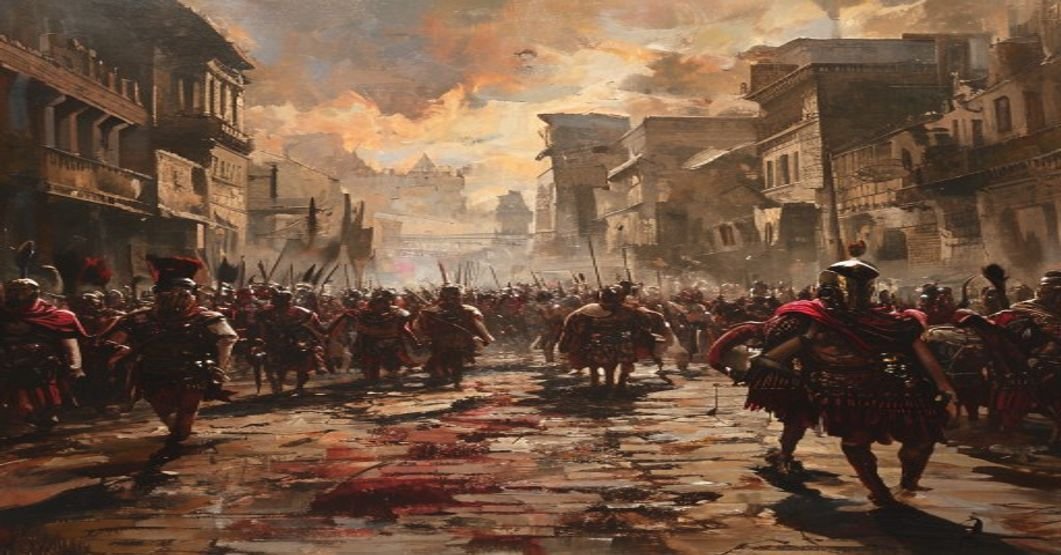
Military populations, crowded into forts and marching camps, were especially vulnerable. Troop strength across the empire fell sharply, and for the first time in Roman history the government began recruiting Germanic warriors wholesale into the legions – not as auxiliaries with limited citizenship rights, but as full soldiers. This was a pragmatic fix with enormous long-term consequences. The Roman army, that supreme instrument of cultural assimilation and imperial control, began its slow transformation into something structurally different.
Marcus Aurelius and the Weight of Catastrophe
Marcus Aurelius, one of the most admired rulers in all of Western history, spent virtually his entire reign managing the fallout of the Antonine Plague. He is remembered today for the Meditations, the private philosophical journal he kept while on military campaign. Readers tend to find in those pages a serene, detached wisdom. What they are actually reading is a man’s attempt to hold himself together while presiding over an empire that was visibly fraying.
Marcus sold imperial jewelry and furniture to fund the legions when the treasury ran low. He appointed special commissioners – curatores – to manage plague-hit Italian towns that could no longer govern themselves. He and his co-emperor Lucius Verus both performed elaborate public religious rites, consulting oracles and appealing to the gods, because the ideological contract between Rome’s rulers and its people demanded visible piety in crisis. Lucius Verus himself died in 169 CE, almost certainly from the plague, leaving Marcus to govern alone under ongoing epidemic conditions.
Marcus died in 180 CE on the Danube frontier, still campaigning. The cause of his death has been debated for centuries. Many historians now believe it was the plague itself, returning in one of its periodic waves. He was 58 years old, worn down by nearly two decades of unrelenting crisis management.
What Galen Recorded – and Why It Matters
Claudius Galenus, known simply as Galen, is often reduced to a footnote about mistaken humoral theory in medical history courses. That characterization misses his extraordinary empirical precision. His descriptions of the Antonine Plague symptoms are specific enough to allow retrospective diagnosis. The skin eruptions he described – appearing on the ninth day of illness, dry rather than moist – match smallpox presentation more closely than any other ancient disease. The gastrointestinal involvement, however, complicates the picture and has led some researchers to propose a hemorrhagic fever variant.
What makes Galen irreplaceable is not just the clinical detail but the social texture he provides. He describes panic in the cities. He records wealthy Romans fleeing to country estates while the urban poor had nowhere to go – a dynamic that will feel familiar to anyone who lived through a modern pandemic. He notes the collapse of normal commerce and the hoarding of food. He is, in short, documenting not just a disease but a society under acute stress.
The Religious Earthquake Nobody Talks About
The Antonine Plague accelerated one of the most consequential religious shifts in human history. Christianity, still a minority sect viewed with suspicion by Roman authorities, responded to the epidemic in a way that paganism’s fragmented priesthoods simply could not match. Christian communities organized care for the sick – including non-Christians – at considerable personal risk. They had a theological framework that made tending the dying not just permissible but morally obligatory. They also had a narrative about death and resurrection that gave the plague a meaning, however terrible, that Roman civic religion struggled to provide.
The sociologist Rodney Stark, in his landmark study The Rise of Christianity, argued that epidemic disease was one of the primary engines of early Christian growth. The practical solidarity of Christian communities during the Antonine and later Cyprianic plagues (the latter struck from around 249 to 262 CE) converted observers who might have remained indifferent to theological argument. You did not have to believe in the resurrection to notice that Christians were the ones bringing water to your dying neighbor.
This is not a point about the truth or falsehood of any religious claim. It is a point about institutional sociology under crisis conditions. The plague created a market, so to speak, for communities offering mutual aid and metaphysical consolation, and Christianity was extraordinarily well positioned to supply both.
The Downstream World
Historians have argued for generations about when Rome’s decline truly began. Edward Gibbon placed the pivot point at the death of Marcus Aurelius, which is suggestive. The Antonine Plague does not explain everything, but it explains more than most textbooks acknowledge.
- Economic contraction: The loss of agricultural labor reduced the tax base for generations. Inflation followed as emperors debased the currency to meet military expenses. The third century would see Roman currency lose roughly 95 percent of its silver content.
- Military restructuring: The integration of Germanic soldiers into the legions fundamentally altered the army’s loyalties and culture over the following century. The soldier-emperors of the third century were a direct product of this transformation.
- Demographic shift: Depopulated regions of Gaul, the Balkans, and Asia Minor were resettled in subsequent decades by non-Roman populations, changing the ethnic and linguistic composition of the empire’s provinces.
- Religious transformation: As noted, the crisis environment accelerated the spread of Christianity and other mystery religions that offered personal salvation – a psychological product the old civic religion had never really manufactured.
None of these consequences were inevitable, and none happened overnight. But the Antonine Plague acted as an accelerant on processes that were already latent in the imperial system. It shortened timelines and lowered thresholds. It made things possible that would otherwise have taken far longer, or might not have happened at all.
Why We Forgot It
The Antonine Plague has been overshadowed in public consciousness by later catastrophes – the Black Death above all. There is something almost unfair about this. The Black Death killed perhaps a third of Europe’s population in the fourteenth century, a staggering figure, but medieval Europe recovered within a few generations and the fundamental structures of Western civilization persisted. The Antonine Plague struck a civilization that was, in some structural senses, more fragile than medieval Europe, and its consequences echoed across centuries.
Part of the reason it has been forgotten is that it lacks a single dramatic narrative moment. The Black Death has the Plague of Florence, Boccaccio’s Decameron, the Dance of Death paintings. The Antonine Plague left us Galen’s clinical notes and Marcus Aurelius’s philosophical journal – important documents, but harder to turn into compelling popular imagery. History tends to remember what it can visualize.
The other reason is that the plague’s effects were distributed across time and space in ways that resist simple storytelling. It did not end Rome in a single season. It weakened Rome incrementally, over fifteen years of outbreaks, across an empire too large to fail quickly. That kind of slow-motion catastrophe is difficult to dramatize and easy to attribute, after the fact, to other causes.
A Crisis With Modern Echoes
Reading about the Antonine Plague in the post-2020 world carries an uncomfortable resonance. The supply chain disruptions, the flight of the wealthy, the improvised community care networks, the government’s simultaneous practical competence and ritual helplessness, the long economic tail that outlasted the outbreak itself – these are not ancient curiosities. They are the recurring grammar of how complex societies respond to pandemic disease.
Marcus Aurelius wrote in the Meditations that obstacles are the way. He did not mean it as motivational poster wisdom. He wrote it as a man who had watched a civilization hemorrhage human life for nearly two decades and had somehow kept the machinery turning. That is a different kind of stoicism – not serenity, but determined function under conditions of irreversible loss. The Antonine Plague is where that distinction was forged.
Related Auburn AI Products
Building a content site at scale? Auburn AI has production-tested kits: