Key Takeaways
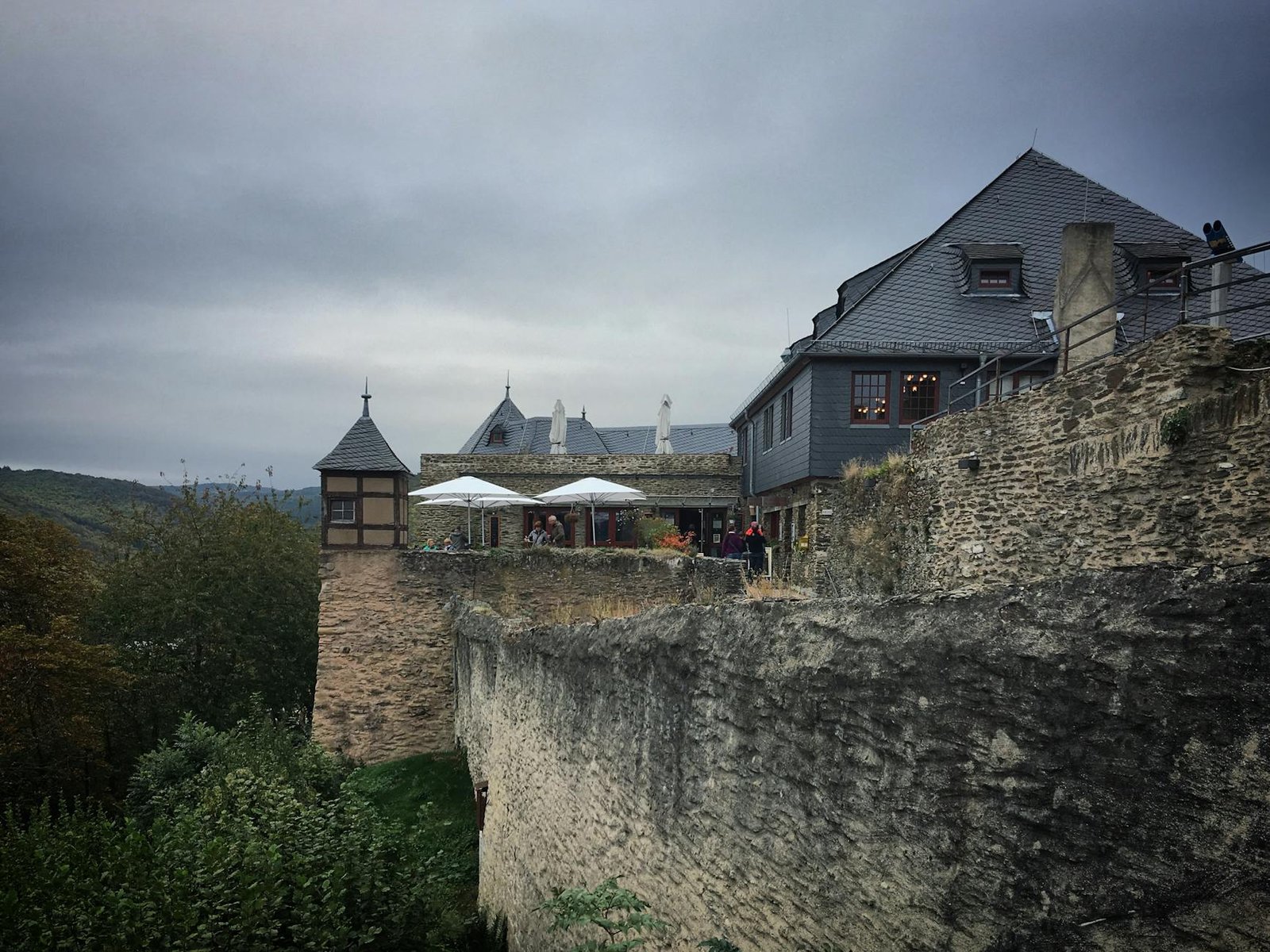
- Marksburg is the only medieval hilltop castle on the entire Rhine that has never been destroyed, razed, or substantially rebuilt — a distinction it holds alone among dozens of Rhine fortifications.
- The castle’s earliest stonework dates to approximately 1117 AD, making it nearly 900 years old and one of the best-preserved examples of Romanesque and Gothic military architecture in Central Europe.
- Perched 160 metres above the Rhine on a sheer volcanic rock spur, Marksburg’s geography alone made it one of the most naturally defensible positions in the entire Holy Roman Empire.
- French Revolutionary forces demolished or damaged over 30 Rhine Valley castles between 1794 and 1797 — yet Marksburg survived because it was repurposed as a military prison rather than treated as a hostile fortification.
- Architect Bodo Ebhardt purchased Marksburg in 1900 for the German Castles Association and conducted one of Europe’s earliest scientifically grounded castle restoration projects, setting standards still referenced today.
- The castle became part of a UNESCO World Heritage Site in 2002 when the Upper Middle Rhine Valley received its inscription, recognising 2,000 years of human history concentrated along 65 kilometres of river valley.
The Single Survivor: Why Marksburg Stands Alone
Here is the fact that stops most people cold when they first encounter it: of the dozens of medieval castles that once studded the Rhine Valley like stone crowns on a river god’s brow, Marksburg is the only hilltop castle that has never been destroyed, captured and razed, or substantially rebuilt from ruin. Every other comparable fortification on this stretch of river — and there were many — was at some point reduced to rubble, gutted by fire, dismantled for its stone, or left to crumble into picturesque decay. Marksburg alone stands as it was built: original walls, original towers, original bones. When you talk about marksburg castle germany dating back to the 12th century without a single catastrophic interruption, you are talking about one of the most extraordinary acts of architectural survival in European history.
That survival is not accidental. It is the product of geography, political cunning, military engineering that was genuinely ahead of its time, and — in one critical moment during the 1790s — a stroke of administrative luck that spared it from the wrecking crews that flattened its neighbours. To understand why Marksburg still stands, you have to understand the world that built it: a medieval Rhine Valley crackling with territorial ambition, ecclesiastical politics, and the relentless logic of controlling one of Europe’s great trade arteries.
Origins and Early Lords: The 12th Century Foundations
The story begins around 1117 AD, when the Lords of Braubach — a minor noble family operating in the complex web of Holy Roman Empire politics — began constructing a fortified position on the volcanic rock spur that rises almost vertically above the small Rhine-side town of Braubach, in what is today the German state of Rhineland-Palatinate. The rock itself, a dramatic outcrop of Devonian slate and quartzite, had almost certainly been used as a lookout or refuge point long before any permanent stone construction began. But it was in the early 12th century that serious military architecture arrived.
The earliest documented reference to a fortification at this site appears in a 1231 charter, where it is listed as “Marcusburg” — most likely a reference to Saint Mark, though historians debate whether the name derives from the patron saint, from a personal name, or from an older Germanic toponym. What is not in dispute is the strategic logic of the location. The Rhine at this point narrows into a gorge, forcing river traffic into a predictable channel directly below the castle’s walls. Any merchant vessel, any military flotilla, any pilgrim barge had to pass within sight — and within arrow range — of whoever controlled the heights above Braubach.
The Holy Roman Empire of the 12th century was not a unified state in any modern sense. It was a patchwork of competing jurisdictions — secular lords, prince-bishops, free cities, monastic territories — all jostling for advantage within a loose imperial framework. Control of Rhine crossings and river tolls was one of the most reliable sources of medieval income, and the Lords of Braubach understood this perfectly. Their castle was, from its earliest days, as much a revenue-generating instrument as a military one.
Archaeological evidence at the site reveals that the initial construction phase produced a relatively compact keep and enclosing wall — typical of Romanesque military architecture of the period. The stone was quarried locally from the same geological formation on which the castle sits, giving the early walls a characteristic grey-blue hue that distinguishes them from later additions. Dendrochronological analysis of surviving timber elements within the castle’s older sections has helped researchers at the Landesamt für Denkmalpflege Rheinland-Pfalz (the Rhineland-Palatinate State Office for Monument Preservation) date specific construction phases with increasing precision, confirming that the core structure predates 1200 with high confidence.
The Katzenelnbogen Era and Marksburg’s Golden Age
The castle’s most transformative period began in 1283, when the Counts of Katzenelnbogen acquired Marksburg. This was a family of considerable political weight in the medieval Rhine Valley — wealthy, well-connected, and deeply invested in the architecture of power in both its literal and figurative senses. Under their stewardship, Marksburg was systematically expanded and upgraded over roughly two centuries, and it is largely their building programme that gives the castle its current silhouette.
The Katzenelnbogen counts were not simply soldiers. They were sophisticated administrators who understood that a castle’s value lay not only in its ability to repel attackers but in its capacity to project legitimacy, house a functioning court, and serve as a secure repository for treasure and documents. They expanded the great hall, improved the residential quarters to a standard befitting noble occupation, and — critically — invested in the fortifications at precisely the moment when the technology of warfare was beginning to shift.
The 14th century brought the first serious challenges to traditional castle design. Gunpowder weapons, still crude and unreliable by later standards, were beginning to appear on European battlefields. The Katzenelnbogen response at Marksburg was to begin adapting the fortifications in ways that would prove remarkably prescient. They thickened the outer walls, lowered certain parapets to reduce their profile as targets, and began constructing the distinctive round tower — the Runder Turm — that would become one of the castle’s most recognisable features. Round towers, as military architects of the period were discovering, deflected projectiles far more effectively than square ones, and they eliminated the blind corners that made square towers vulnerable to undermining.
The counts also maintained Marksburg as a working toll station. The Rhine toll system of the medieval period was an extraordinarily complex fiscal mechanism, with dozens of competing toll stations along the river’s length extracting fees from passing traffic. Scholarly work by historian Johannes Mötsch, drawing on surviving Katzenelnbogen account books held in the Hessian State Archives in Marburg, has documented the considerable revenues that flowed through Marksburg during the 14th and 15th centuries. These revenues funded not just construction but also the political alliances that kept the castle out of the crosshairs of more powerful neighbours.
When the Katzenelnbogen line died out in 1479, Marksburg passed to the Landgraves of Hesse — another powerful dynasty, and one that continued the tradition of treating the castle as a strategic asset worth maintaining rather than a liability worth abandoning. The Landgraves used it variously as a residence, a treasury, and — increasingly as the 16th and 17th centuries progressed — as a prison for high-status captives. This last function would prove unexpectedly important to its survival.
Siege Warfare, Military Engineering, and Why No Army Ever Took It
To appreciate why Marksburg was never captured, you need to think like a medieval siege commander standing at the base of that rock in, say, 1350, looking up at 160 metres of near-vertical cliff topped by stone walls and a garrison of determined defenders. The fundamental problem is immediately apparent: there is almost nowhere to position siege equipment with a clear line of attack. The rock spur on which the castle sits is not a gentle hill. It is a geological spike, steep on all sides, with only a single approach path that winds up through multiple defensive gates and killing grounds.
Medieval siege warfare relied on a fairly consistent toolkit: starvation blockades, mining operations to collapse walls, trebuchets and mangonels hurling projectiles, and direct assault with scaling ladders or siege towers. Marksburg’s geography neutralised most of these options simultaneously. A starvation blockade required surrounding the target completely — extremely difficult on a near-vertical rock with a river on one side. Mining was essentially impossible given the solid Devonian rock on which the castle sat; you cannot tunnel under a castle that is built directly on bedrock. Trebuchets needed relatively flat ground at a useful range; the terrain around Marksburg denied attackers any such position. And direct assault up a single winding path, through multiple fortified gates, against defenders who could pour boiling water, drop stones, and fire crossbow bolts from positions of complete cover — that was simply a death sentence for the attacking force.
The castle’s internal layout reinforced these natural advantages. Visitors today can still walk through the sequence of gates and barriers that an attacker would have faced: the outer gate, the middle gate, the inner gate, each designed so that even if the previous one fell, the defenders could fall back to a stronger position and continue resistance. The well inside the castle — essential for withstanding any prolonged siege — was sunk deep into the rock and is believed to have reached the water table reliably, removing the threat of thirst that ended so many medieval defences.
The castle’s armaments collection, now one of the most comprehensive medieval weapons displays in Germany, includes examples of the crossbows, polearms, and early firearms that successive garrisons would have used. The German Castles Association, which has curated this collection since 1900, holds records showing that the castle maintained an active armoury well into the early modern period, adapting its weapons inventory as military technology evolved. The transition from crossbows to early firearms, from trebuchets to cannon, is documented in the castle’s own procurement records — a rare primary source window into how a real medieval garrison thought about its own defence.
For readers fascinated by the mechanics of medieval fortification and how castles like Marksburg were designed to make attackers’ lives miserable, the engineering principles at work here share much with the broader tradition of European defensive architecture. The same logic that made technological adaptation so critical across centuries of military history was already operating in the minds of Marksburg’s medieval builders — the understanding that defensive advantage is always temporary, and that survival requires constant reinvestment in the tools of resistance.
The French Revolutionary Wars and Marksburg’s Closest Call
The most dangerous moment in Marksburg’s long history came not from a medieval army with trebuchets but from the rationalising fury of the French Revolutionary Republic. Between 1794 and 1797, French forces under generals including Jourdan and Moreau swept through the Rhineland, dismantling the feudal order that had governed the region for centuries. Part of this programme involved the systematic demolition or disabling of Rhine Valley castles — fortifications that represented both the military power of the old aristocratic order and a practical threat to French control of the river.
The scale of destruction was enormous. Historians estimate that French forces damaged or destroyed more than 30 significant Rhine Valley castles during this period. Rheinfels, once the mightiest fortress on the Rhine, was blown up in 1797. Ehrenbeitstein was besieged and eventually demolished. Castle after castle that had stood for centuries was reduced to the picturesque ruins that 19th-century Romantic painters would later immortalise. The Rhine Valley’s landscape of ruins — which so enchanted writers like Byron and painters like Turner — was largely created in a few years of Revolutionary-era demolition.
Marksburg survived because of a bureaucratic accident of categorisation. By the late 18th century, the castle had long since ceased to function as an active military fortification and was being used primarily as a prison — at various points housing political prisoners, debtors, and common criminals under Hessian administration. When French administrators assessed the Rhine Valley’s castles for demolition, Marksburg’s classification as a prison rather than an active military installation appears to have spared it from the wrecking orders that condemned its neighbours. It was simply more useful intact than as rubble.
This is a pattern that recurs throughout the history of heritage survival: the buildings that endure are often those that found a new purpose at the critical moment when their original purpose became obsolete or threatening. Marksburg’s centuries of adaptive reuse — toll station, treasury, residence, prison — gave it the institutional flexibility to survive transitions that destroyed less versatile structures.
After the Revolutionary Wars, the castle passed through various administrative hands before coming under Prussian control in the 19th century. By the 1890s, it had fallen into significant disrepair — not destroyed, but neglected, its roofs leaking, its walls crumbling at the edges, its interiors stripped of much of their furnishing. It was at this point that the man who would become its modern saviour appeared.
Bodo Ebhardt and the Birth of Scientific Castle Restoration
Bodo Ebhardt was born in 1865 in Brunswick and trained as an architect at a time when the question of how to treat historic buildings was becoming one of the great intellectual debates of European cultural life. The 19th century had produced two broad schools of thought on historic restoration: the interventionist approach, associated with the French architect Eugène Viollet-le-Duc, which held that a restorer should complete a historic building as it “ought” to have looked, even if that meant inventing elements that never existed; and the conservationist approach, associated with the English critic John Ruskin, which held that authentic historic fabric was sacred and should be preserved rather than supplemented.
Ebhardt charted a middle course that was, for its time, unusually rigorous. When he founded the Deutsche Burgenvereinigung (German Castles Association) in 1899 and acquired Marksburg as its headquarters the following year, he brought to the project a commitment to archaeological evidence and documentary research that distinguished his work from the more romantic restorations happening elsewhere in Germany — most notoriously at Hohkönigsburg in Alsace, where Kaiser Wilhelm II’s preferred approach produced something closer to a fantasy castle than a historically accurate reconstruction.
At Marksburg, Ebhardt’s team systematically excavated the castle’s foundations, analysed surviving masonry for evidence of original construction techniques, consulted medieval chronicles and account books, and studied comparable surviving castles across Europe before making any significant interventions. The result was a restoration that, while not perfect by modern standards — archaeological thinking has advanced considerably since 1900 — was genuinely grounded in evidence rather than imagination. The Deutsche Burgenvereinigung still holds the records of Ebhardt’s research at Marksburg, and these documents have themselves become primary sources for later historians studying both the castle and the history of heritage conservation.
Ebhardt’s work at Marksburg was also significant because it established the castle as a teaching institution. From the early 20th century onwards, Marksburg served not just as a museum but as a research centre and training ground for the emerging discipline of castle studies. Scholars from across Europe came to study its construction techniques, its defensive systems, its domestic arrangements. The castle became, in a sense, the classroom in which a generation of European heritage professionals learned their trade.
Marksburg Today: UNESCO, Tourism, and Living History
In 2002, the Upper Middle Rhine Valley — a 65-kilometre stretch of river valley running from Bingen to Koblenz — was inscribed as a UNESCO World Heritage Site. The inscription recognised what the citation called “an outstanding example of a landscape that illustrates several significant stages in human history.” Marksburg, as the only intact medieval hilltop castle in the valley, was central to that recognition.
Today, the castle receives approximately 100,000 visitors per year, making it one of the most visited historic sites in Rhineland-Palatinate. Guided tours — conducted in multiple languages, including English — take visitors through the full sequence of the castle’s spaces: the outer defences, the great hall, the kitchen (where a remarkably complete set of medieval cooking equipment is displayed), the chapel, the residential quarters, and the armoury. The tour route is itself a kind of argument about how the castle worked, moving visitors through the same spatial logic that governed medieval life within its walls.
The German Castles Association continues to maintain its headquarters at Marksburg, and the castle’s library and archive — containing thousands of documents, photographs, and research files relating to German castles — remains an active scholarly resource. Researchers studying questions of medieval military architecture, noble residential culture, or the history of heritage conservation regularly work in the castle’s collections.
The castle also sits within a broader cultural landscape that rewards exploration. The Rhine Gorge between Koblenz and Bingen is one of the most historically dense landscapes in Europe — a place where Roman fortifications, medieval castles, Baroque churches, and 19th-century Romantic-era constructions layer over each other in a palimpsest of human ambition. Understanding Marksburg means understanding this landscape, and understanding this landscape means engaging with two millennia of European history compressed into a river valley that you can drive the length of in under an hour.
For readers who find themselves drawn to the way that physical places accumulate historical meaning — the way a landscape becomes a kind of three-dimensional archive — the Rhine Valley offers one of Europe’s richest experiences. It is a reminder that history is not only in books and museums but in the stones of walls that have been standing since before the Black Death, before the printing press, before the Reformation changed everything.
Rhine Castles Compared: A Historical Overview
| Castle | Founded | Current State | Key Event | UNESCO Listed |
|---|---|---|---|---|
| Marksburg | c. 1117 | Fully intact — never destroyed | Survived French Revolutionary demolitions | Yes (2002) |
| Rheinfels | 1245 | Ruin | Blown up by French forces in 1797 | Yes (2002) |
| Ehrenbeitstein | c. 1000 | Partially rebuilt (Prussian era) | Demolished by French; rebuilt 1817–1828 | No |
| Pfalzgrafenstein | 1326 | Largely intact | Never captured; island position key | Yes (2002) |
| Stahleck | c. 1100 | Rebuilt (1925–1967) | Destroyed in Thirty Years’ War; rebuilt as youth hostel | Yes (2002) |
| Gutenfels | c. 1200 | Restored (19th century) | Fell into ruin; Romantic-era restoration | Yes (2002) |
Essential Books on Medieval Castles and the Rhine Valley
As an Amazon Associate and Audible affiliate, HistoryBookTales.com earns from qualifying purchases. Start your free 30-day Audible trial here.
Whether you are planning a visit to Marksburg or simply want to go deeper into the world of medieval fortification, these books and audiobooks will reward every hour you spend with them.
Physical Books
1. “Castles: Their History and Evolution in Medieval Britain” by Marc Morris
Marc Morris is one of the finest popular historians working in the field of medieval military architecture, and this beautifully illustrated volume traces the evolution of castle design from the Norman Conquest through the late medieval period. While focused on Britain, the engineering and social principles it explains apply directly to continental castles like Marksburg, making it an invaluable companion for anyone seeking to understand why these structures were built the way they were.
Check price on Amazon
2. “The Medieval Castle: History and Legend” by Plantagenet Somerset Fry
A comprehensive survey of European castle history that places Rhine Valley fortifications in their broader continental context. Fry’s treatment of siege warfare is particularly strong, and his analysis of how castle design evolved in response to changing military technology illuminates exactly the kind of adaptations we see at Marksburg across its nine centuries of history.
Check price on Amazon
3. “The Rhine: Following Europe’s Greatest River from Amsterdam to the Alps” by Ben Coates
Coates takes readers on a journey down the entire length of the Rhine, weaving together history, culture, and contemporary observation in a narrative that captures both the grandeur and the intimacy of this extraordinary river. His treatment of the Rhine Gorge and its castles is vivid and historically informed, making this an ideal companion for anyone wanting to understand Marksburg within its full geographical and cultural context.
Check price on Amazon
Audiobooks
4. “The Time Traveller’s Guide to Medieval England” by Ian Mortimer (Audiobook)
Mortimer’s landmark work reconstructs what it actually felt like to live in medieval England — the smells, sounds, social hierarchies, and physical realities of a world that produced buildings like Marksburg. Hearing this narrated brings the medieval world to life in a way that reading alone rarely achieves, and it provides essential context for understanding the human beings who built, garrisoned, and lived within these stone walls.
Listen free with Audible trial
5. “Strongholds of the Border” by Various (Medieval Castle History Audiobook)
For listeners who want to go deep on the military engineering and social history of medieval fortifications, this audiobook collection draws on academic research to explore how castles functioned as centres of power, administration, and daily life. The production quality is excellent, and the content bridges the gap between popular history and serious scholarship in a way that rewards attentive listening.
Listen free with Audible trial
For further reading on how medieval societies built and maintained power through physical structures, the Smithsonian Magazine has published excellent accessible overviews of European castle architecture, and the English Heritage organisation maintains a substantial online resource on medieval fortification that complements any visit to continental sites like Marksburg.
Historians also debate whether the standard narrative of Marksburg’s unbroken survival is entirely accurate or whether certain later medieval repairs were more substantial than the “never rebuilt” framing suggests. Academic work published in the Burgen und Schlösser journal — the Deutsche Burgenvereinigung’s own scholarly publication — has explored this question with admirable rigour, concluding that while significant repairs were made at various points, no phase of the castle’s history involved demolition and reconstruction of primary structural elements. The distinction matters: there is a difference between maintaining a living building and rebuilding a ruin, and Marksburg has always been the former.
The broader story of how medieval societies organised themselves around fortified centres connects to some of the deepest questions in European history. The way that power concentrated in stone — and the way that stone outlasted the people who built it — is a theme that runs through everything from the Roman forts that preceded Marksburg along the Rhine to the 19th-century nation-states that eventually took custody of these ancient structures. For readers interested in how physical objects carry historical meaning across centuries, the study of medieval castles offers one of the richest possible entry points into that conversation. It shares something with the way that burial objects from the Yuan Dynasty reveal unexpected cultural crosscurrents — material culture as a window into worlds that written records alone cannot fully illuminate.
Love History Trivia?
Test your knowledge with our History Trivia Book – 100 challenging questions designed for true history enthusiasts.
What This Means Today: Heritage, Survival, and the Fragility of History
Marksburg Castle is not simply a beautiful old building on a dramatic rock above a famous river. It is a lesson in the conditions that allow history to survive. The lesson is not comfortable. Marksburg’s survival was never guaranteed. It required, at various critical moments, the right political classification, the right administrative decision, the right individual — Bodo Ebhardt — arriving at the right time with the right combination of resources and conviction. Remove any one of those factors and Marksburg almost certainly joins the long list of Rhine Valley ruins: picturesque, evocative, but fundamentally incomplete as a historical document.
This matters today because the pressures that destroy historic sites have not disappeared. They have changed form. The French Revolutionary wrecking crews have been replaced by development pressures, funding shortfalls, climate change — rising river levels and increased rainfall are genuine threats to Rhine Valley heritage sites — and the simple entropy of neglect. UNESCO inscription helps, but it is not a guarantee. The Upper Middle Rhine Valley’s World Heritage status has been accompanied by ongoing debates about development within the protected zone, with UNESCO itself issuing warnings about proposed infrastructure projects that could compromise the landscape’s integrity.
There is also a deeper point about what intact historic sites like Marksburg offer that ruins and reconstructions cannot. When you walk through Marksburg’s gates, you are walking through the same physical space that a 14th-century Katzenelnbogen count walked through, that a 16th-century Hessian garrison soldier walked through, that a Revolutionary-era French administrator walked through and decided — for whatever bureaucratic reason — to leave standing. That continuity of physical experience is irreplaceable. It connects us to the past not through imagination or reconstruction but through the actual shared experience of space and stone.
The study of how societies build, maintain, and lose their physical heritage connects to some of the broadest questions in historical thinking — questions about power, memory, identity, and the relationship between past and present. Those questions are as alive today as they were when the Lords of Braubach first began cutting stone on that volcanic spur above the Rhine. They deserve to be taken seriously, which means taking seriously the places — like Marksburg — where history has managed, against considerable odds, to survive intact.
If this story of survival, siege warfare, and medieval engineering has fired your curiosity, the best next step is to reach for one of the books recommended above. Marc Morris on medieval castles, Ben Coates on the Rhine, Ian Mortimer on the medieval world — any of them will deepen your understanding of what Marksburg represents and why its nine centuries of unbroken survival matter. History is always richer when you go looking for the details, and the details here are extraordinary.
For those who enjoy connecting the dots between different historical traditions — the way that medieval European castle-building shares underlying logic with fortification traditions from ancient Rome to imperial China — our exploration of how Augustus built Roman imperial power offers a fascinating parallel study in how great civilisations construct and project authority through physical means.